"We're pleased to share the first ever in-game trailer for The Elder Scrolls V: Skyrim, the next installment in The Elder Scrolls series from award-winning creators of The Elder Scrolls IV: Oblivion and Fallout 3, Bethesda Game Studios. "
You might find you need to log into Youtube to view the trailer for age verification.
It seems Skyrim will be released world-wide on 11.11.11 on the Xbox 360, PlayStation 3 and PC ... so something to look forward to at the end of the year other than the cold weather. If they release another instalment of Fallout at the same time ... then hibernation this coming winter will just not be an option
Time is proving to be a most scarce commodity at the moment. So having a few hours spare I set myself some tasks and as usual did something completely different :rolleyes: I started work on a room and ended up on a new 90 degree section, corridor doorway section (with separate reusable door frame / doors and simple placeholder keypad switch box all to need textures), a few WIP scripts for the doors and some hashed together sound FX for them to and a short corridor "Door Plug" section to allow the standard sections to fit the door frame. Part of the plan for this modular approach to the level is that as many sections/parts as possible will be able to "plug" into each other. I also wanted to test out some new base metal textures to try and break up the "monotone" look. The door keypad switch would also require some sort of 3rd person object interaction functionality which was hastily coded and again as with everything else, still very much a WIP.
Simple keypad switch prop:
Development in Silo PRO:
A quick medium resolution video to show the "worksite" test scene. I can't take credit for the blue and yellow textures they are curtesy of Paint.NET's floodfill tool..
Hopefully next week I will be able to free up more than only a few hours to get fully back into this "adventure", but I was not unhappy with the progress I made in only two hours.
With the basic texture workflow pretty much sorted for the modular level design (see here), I have turned my attention to getting a scale I am happy with. When this is done then after each section is modelled and then UV mapped it should be just a simple case of converting to .gmf format (famous last words). Scaling seems to be an issue that crops up across all the engines I use. But truthfully it matters not what others scale to, but that the relative scaling used in a scene is consistent for all static and animated meshes from props to scene to characters. LE has a scale of 1 unit is about 1m, I simply use 1 unit as 1m, therefore a character needing to be 6 foot tall would simply be a "metric" 6 foot.. or 1.8 units. This is the rule of thumb I use for all scenes and corresponding code. But sometimes its also good to check how it looks by eye. In a 3rd person situation its not just the scale of the level and the characters but having to remember the camera offset and how this would be effected. I normally do two tests, a simple static scene with characters and props placed to get a simple overall picture of the scaling.
And I like to knock up a quick app with a basic 3rd person collision cam and have a quick walk through (HD available):
So far I am happy with the results which means when time permits I can get on with creating the rest of the sections/rooms ect. I have also checked the scaling to make sure I can easily "block out" the level and run it through my pathfinding mapdata generator app which I had some success with in earlier tests of A* pathfinding (see here).
Firstly, I'd like to take this opportunity to wish you all a belated happy new year. I hope you all have had a great start to it.
I have not been doing much on the coding front for the last few weeks. I decided to get some assets created and try and develop my texturing skills a little further.
I also purchased Silo 3D Pro over the Christmas period as it was on offer. I had used the demo and was impressed at how "comfortable" it was to use. I now use this package as my main modeller but in conjunction with AC3D and UU3D. Basically Ultimate Unwrap 3D is the junction where all my modelling and art packages meet. Not only for Leadwerks with its .gmf export for both static meshes and animated assets but for all the engines I use, for me its an invaluable tool and a good investment for the minimal cost.
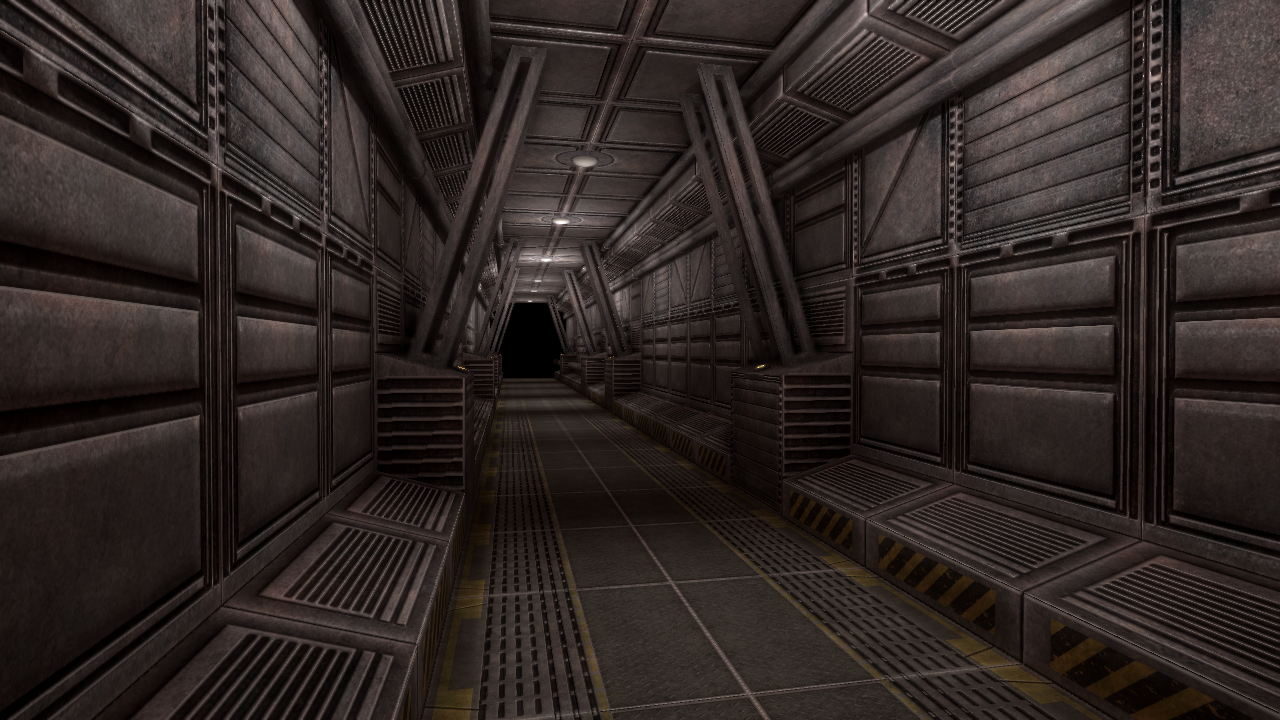
I have need of a modular corridor/room set, and decided to set about seeing just how low you can go with the poly count and how much you can offset the inherent "flatness" of a low poly environment with normal mapping and "hand painted" textures. This would be moving on directly from a previous flirtation with texturing which can be found here. Some more incriminating evidence can be seen in the gallery as well, fairly obvious I am no artist.
Another aspect of texturing I have been playing with is bump mapping. I use ShaderMap Pro which is great but making bumpmaps from diffuse textures can have horrible "side effects" when creating panelling.
Diffuse only:
Diffuse and Normal map created directly from the Diffuse texture by ShaderMap Pro:
Not really the effect I was after. After a few ideas and some testing I found hand crafting a Normal map "template" from which a Normal map would be generated by ShaderMap Pro gave much better results for this exercise.
I then made the first test section of the low poly modular level pack:
The textures were then UV mapped onto the section in UU3D and then converted all over to .gmf .dds and created the .mat files using ADN ... I love ADN truly one of the most useful tools written by a community member ever!!
I Lined a few of them up just for show .. 480 polys not bad .. considering the default rusty oildrum is 256.
Encouraged by the result thus far I moved on, making the section bigger but retaining the tilable nature of the textures
Unfortunately real life commitments caused a pause in my endeavours until a day ago so I have spent the last few hours refining some aspects and making a few more test sections:
The overall effect of the technique I am developing can be seen better in this video (HD available):
This is currently the point I am at, With some preliminary drafts for doors/doorways rooms and elevators/elevator shafts ect. I am trying to reach a point where variation is only a texture change away on standard section low poly models. I am still getting my templates organised and fine tuning the work flow and still very much a WIP, but so far I am quite pleased with the results.


.png "English")